Download Ebook Descent into Chaos: The U.S. and the Disaster in Pakistan, Afghanistan, and Central Asia, by Ahmed Rashid
It is not take in when you have to do something with your requirement. If you truly need sources as well as ideas associated with this inspiring topic, you can do it. It can be done by you to find with us and locate the web link. While Descent Into Chaos: The U.S. And The Disaster In Pakistan, Afghanistan, And Central Asia, By Ahmed Rashid makes you feel curious, it will certainly finish the interest as well as finish it up after ending up reading this book.
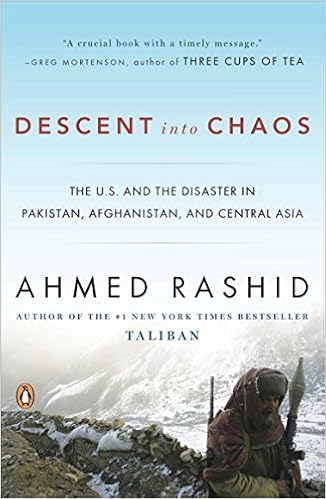
Descent into Chaos: The U.S. and the Disaster in Pakistan, Afghanistan, and Central Asia, by Ahmed Rashid

Download Ebook Descent into Chaos: The U.S. and the Disaster in Pakistan, Afghanistan, and Central Asia, by Ahmed Rashid
Ultimate book collections can be gotten if you constantly visit this web page. Locate the million of books right here. All categories from lots of resources, authors, as well as writers around the world exist. We not just supply the book collections from inside of this nation. Many accumulated publications are from the outsiders. Nonetheless, the purposes are exact same. They are given as an unified library by on-line to offer even more valuable resources to obtain guide.
Checking out is not for other individuals who obligate or order you to check out. The one that can appreciate and also make use of the advantages of analysis is you. So, it is not kind of even worse when you are aiming to be much better by analysis. Even reading will certainly not lead you to be successful 100%; in this manner can aid you to meet the condition, lesson, experience, as well as knowledge. Moreover, this book qualified Descent Into Chaos: The U.S. And The Disaster In Pakistan, Afghanistan, And Central Asia, By Ahmed Rashid also becomes one that is actually prominent.
Obtaining the contended web content of the book also in the soft file is actually remarkable. You can see how the Descent Into Chaos: The U.S. And The Disaster In Pakistan, Afghanistan, And Central Asia, By Ahmed Rashid exists. Before you obtain guide, you may unknown concerning just what the book is. However, for even more sensible thing, we will certainly share you little bit about this book. This is guide to suggest that provides you a good idea to do. It is additionally offered in very captivating recommendation, example, and also description.
Coming with some experiences to find the excellent book will certainly not make you fell short in choosing various other publication to read. As this publication, you may not regret and also really feel doubt to pick it as your analysis product. This Descent Into Chaos: The U.S. And The Disaster In Pakistan, Afghanistan, And Central Asia, By Ahmed Rashid has actually verified that it has great web content, excellent outcome, great chance, and good condition. The writer has produced this publication with very outstanding product to check out by everybody. This is what makes the people plan to read this publication.
Review
"Not only provides thoughtful, detailed dissection of seminal events in Central Asian recent history, but an insightful snapshot into future scenarios of where the roadmaps to terror and peace may be headed." -Greg Mortenson, author of The New York Times bestseller Three Cups of Tea "Powerful." -Wolf Blitzer "Rashid, a Pakistani journalist, is that most valuable of political analysts: both insider and outsider to the problem he studies. His book should be read by anyone pondering how America might stop widening Osama bin Ladin's pool of bomb-clad volunteers." - Chicago Tribune "[A] brilliant and passionate book." -The New York Review of Books
Read more
About the Author
Ahmed Rashid is a journalist who has been covering Afghanistan, Pakistan, and Central Asia for more than twenty years. He is a correspondent for the Wall Street Journal, Far Eastern Economic Review, Daily Telegraph, and The Nation, a leading newspaper in Pakistan. His #1 New York Times bestseller Taliban has been translated into more than twenty languages.
Read more
Product details
Paperback: 560 pages
Publisher: Penguin Books; Revised edition (April 7, 2009)
Language: English
ISBN-10: 014311557X
ISBN-13: 978-0143115571
Product Dimensions:
5.5 x 1.2 x 8.5 inches
Shipping Weight: 1 pounds (View shipping rates and policies)
Average Customer Review:
3.8 out of 5 stars
53 customer reviews
Amazon Best Sellers Rank:
#623,593 in Books (See Top 100 in Books)
Ahmed Rashid is a journalist, and a good one at that. He is courageous, and the reader cannot help but marvel that he has not met an "untimely end" due to his criticism of various leaders. From his base in Lahore, Pakistan he has had a vital "South-central Asian" perspective on many of the events that have become of essential importance to the United States, and to a large extent, the Western world, in the "post 9/11 era." His "beat" is Afghanistan, the five central Asian "'stans," India, and his native country. His book Taliban: Militant Islam, Oil and Fundamentalism in Central Asia, Second Edition, written in 2000, became essential reading for American policy makers a year later.Rashid's book is an essential compliment to Junger's book WAR. Junger covers the combat conducted over a year's period, by one unit of the 173rd Airborne Brigade, in a remote valley near the Pakistani border. To quote Junger: "The men know Pakistan is the root of the entire war, and that is just about the only topic they get political about." Rashid covers in detail the internal political situation in Pakistan, most tellingly, the "double game" that has been played, and continues to be played by the Inter-Services Intelligence Directorate (ISI), which is Pakistan's intelligence agency. Numerous members of the agency openly support the Taliban, while paying lip service to the Americans that they are fighting them. One of the most astonishing vignettes told by Rashid is dubbed "the Great Escape." It occurred on November 15, 2001, when there was an imposed lull in the fighting at Kunduz, so that Pakistani planes could fly in and evacuate members of the ISI, and untold number of Taliban, to Pakistan, thwarting the efforts of the United States, and the Northern Alliance, in the very early days of the ground combat in Afghanistan post 9-11. Rashid documents again and again how the American leadership turns a blind eye to the ISI's double-dealing, and continues to support General Musharraf's dictatorial rule of Pakistan, and his double-dealing with the reactionary forces of Islamic fundamentalism.But there is much else besides. Rashid knew Hamid Karzai before he become Afghanistan's current leader. He gave a concise account of his background, and the logic behind his selection by the Americans. Karzai is a Pashtun counterweight to the Northern Alliance. His coverage of "the Stans" is incisive. Each ruled by a dictator, who milk the Americans for rights to bases. Graft and corruption are the norm; the ruling elite become fabulously rich, which only helps fuel an Islamic fundamentalist backlash in each of these countries. Telling, Rashid echoes a variation of a once famous question in the American `50's: Who lost Uzbekistan? Rashid also provides vital explanations of what he terms "Al Qaeda bolt-hole," which are their sanctuaries in the Northwest frontier provinces. Is Osama Bin Laden still there? Rashid draws no definitive conclusions, but the continued lack of real interest in bringing him to justice, almost 10 years after 9/11 remains disturbing.Rashid frequent travels to the West provide an opportunity to report on the Western leaders as well. He renders scathing indictments of the American "neo-con" leadership, Cheney, Rumsfeld et al., and how they blew a truly wonderful opportunity in Afghanistan by refusing to engage in even modest "nation building," a term anathema to them, and their almost total focus of Iraq, which created the conditions for the Taliban to become resurgent.Is imitation the sincerest form of flattery? A telling anecdote is on the author's website, easily reached via Google. George Bush, in his book Decision Points lifted Rashid's account (without attribution) of the meeting between Karzai and a Tajik warlord on Dec. 22, 2001But I did have some problems with the book, and found it a bit of a slog to finish. Journalists, to generalize somewhat, seemed inclined to produce "cut and paste" books from their work. The book could use much tighter editing; for example, three times in three pages the reader is told that East Pakistan became Bangladesh in 1971. The history of Pakistan, as related in Chapter Two, has a "stream of consciousness" style about it. And there are numerous misspellings, the type that even a reasonable publisher would have caught via "spell-check." Rashid clearly has his opinions on various individuals, for example, "brutal," "corrupt", and renders them, but sometimes without providing the reader with his basis. Another reviewer, Timothy Graczewski, calls the author out on his statements about Toyota Landcrusiers travelling 150 mi/hr in the open desert. Did he mean kilometers? Doesn't matter. Anyone who has travelled in the open desert knows, that, save for perhaps the Bonneville Salt Flats in Utah, you cannot travel that fast due to the wadis, and innumerable dry water courses that would destroy the suspension on any vehicle.Overall though, a vital, essential book. It was published just before President Obama took office. With the President's increased focus on this area, including augmented troop levels, Rashid's account is more important than ever, and will almost certainly be the most comprehensive view of the area that will be available in the West. 4-stars.
Let me begin by saying that I liked Descent into Chaos by Ahmed Rashid because it provided a useful and readable of the events surrounding Pakistan and Afghanistan leading up to and post 9-11 and the United States war there. However, the book is labeled as a discussion of the failure of nation-building in Central Asia. Most of the chapters revolve around Afghanistan and Pakistan with a brief word tied in occasionally about the other countries. The point that the fates of all of these places is interconnected because they deal with many of the same problems of radical extremism, ruling corruption, and bad economic and educational conditions, but I would've wanted to hear a little bit more about the other countries of the Central Asia regions he discusses. I was also concerned when he referred to Harmid Karzai as his good friend in the first few pages of the book that it was going to be a Karzai love piece...by taking care to criticize Karzai for failings at several points he alleviated those concerns. Overall a good book on the nuts and bolts of Afghanistan and Pakistan, but you'll need another book to dig further into the larger Central Asia region.
Rashid's book is an in depth look at the mistakes made by the US in post-war Afganistan. Mistake # 1 was believing that we could trust or count on the Pakistani government. It spells out in unprecedented detail how Pervez Musharaf, the Pakistani military and the Pakistani Intelligence services took the Bush administration for a ride, by being our "ally" against Al Qaeda and simultaneously supporting the Taliban. Mistake # 2: Rumsfeld's policy of buying the cooperation of Afgan warlords in the search for Al Qaeda, who as we now know had already found their way in to Pakistan. Rashid also puts into context the warlords on the US pay-roll ( Wolfowitz likes to call them "regional leaders") who carved up Afganistan and billions in reconstruction funds. He makes a compelling argument that the war lords and the US policy of buying them off was the chief obstacle to reconstruction and the establishment of government rule in Afganistan. I think the book is overly generous and forgiving of Hamid Karzai (though Rashid makes it clear that he is a friend and admirer of Karzai on the very first page) because it never really addresses the issues surrounding the reasons that the Pashtuns viewed him as untrustworthy. Beyond being a first class journalist, Rashid is an insider's insider in this world and the book provides a level of insight and detail that only he could give.
Ahmed Rashid, is the bravest and most talented writer/journalist I know of when it comes to Central and Southern Asia!!! He had actually been invited by the U.S. Government as an advisor. He has also meant with, and is a good friend of Hamid Karzai. I am reading Descent Into Chaos now, I am half way through; like all the other books Mr. Rashid has written... it's excellent! I would recommend this book to anyone studying international relations/studies; or anyone that wants to know what's going on in Afghanistan, Pakistan, India, and the other central Asian countries. I will be looking for new books from Mr. Rashid; I hope he keeps on writing for another twenty years! God Bless you Ahmed; you're a teacher, writer, journalist, and expert in International Studies/Relations....
Descent into Chaos: The U.S. and the Disaster in Pakistan, Afghanistan, and Central Asia, by Ahmed Rashid PDF
Descent into Chaos: The U.S. and the Disaster in Pakistan, Afghanistan, and Central Asia, by Ahmed Rashid EPub
Descent into Chaos: The U.S. and the Disaster in Pakistan, Afghanistan, and Central Asia, by Ahmed Rashid Doc
Descent into Chaos: The U.S. and the Disaster in Pakistan, Afghanistan, and Central Asia, by Ahmed Rashid iBooks
Descent into Chaos: The U.S. and the Disaster in Pakistan, Afghanistan, and Central Asia, by Ahmed Rashid rtf
Descent into Chaos: The U.S. and the Disaster in Pakistan, Afghanistan, and Central Asia, by Ahmed Rashid Mobipocket
Descent into Chaos: The U.S. and the Disaster in Pakistan, Afghanistan, and Central Asia, by Ahmed Rashid Kindle
Descent into Chaos: The U.S. and the Disaster in Pakistan, Afghanistan, and Central Asia, by Ahmed Rashid PDF
Descent into Chaos: The U.S. and the Disaster in Pakistan, Afghanistan, and Central Asia, by Ahmed Rashid PDF
Descent into Chaos: The U.S. and the Disaster in Pakistan, Afghanistan, and Central Asia, by Ahmed Rashid PDF
Descent into Chaos: The U.S. and the Disaster in Pakistan, Afghanistan, and Central Asia, by Ahmed Rashid PDF